
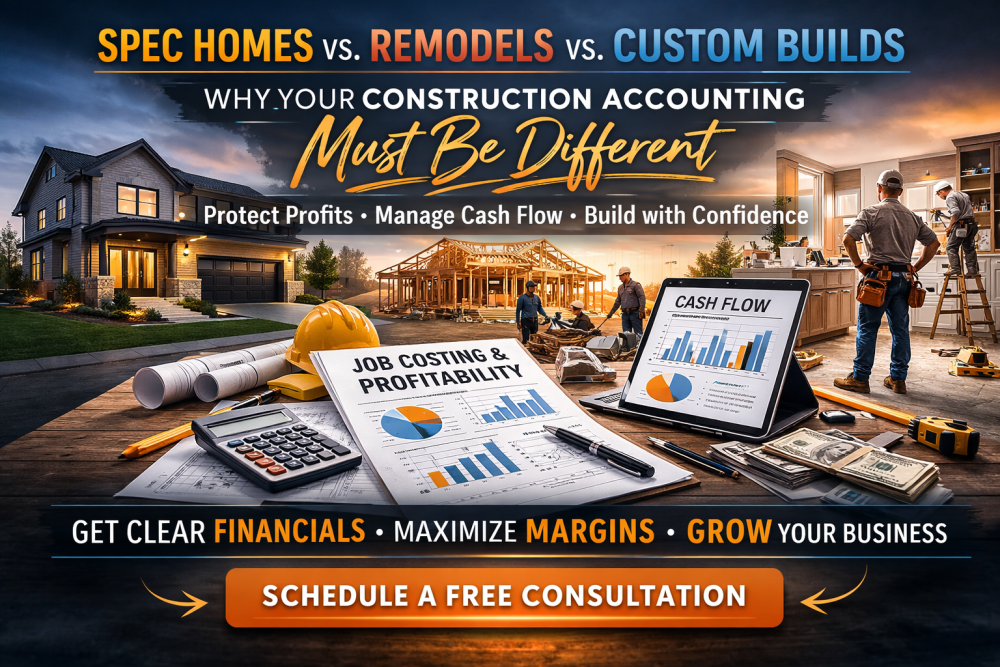
Spec Homes vs. Remodels vs. Custom New Construction: Why Construction Accounting Must Be Structured Differently
Not all construction projects are financially the same.
Spec homes, custom new construction, and remodeling projects may share crews and materials — but from a construction bookkeeping and accounting perspective, they operate on completely different financial models.
When your accounting system treats them the same, you lose visibility into:
-
True job profitability
-
Capital exposure
-
Cash flow risk
-
Labor efficiency
-
Margin performance
At JL Bookkeeping Design, I specialize in construction bookkeeping systems that reflect how builders actually operate — so you can make informed, confident business decisions.
Let’s break down why each project type requires a different financial approach.
Spec Home Accounting: Managing Capital and Risk
Spec homes (speculative builds) are funded entirely by the builder. You carry the lot, materials, labor, interest, and holding costs until the property sells.
Financial Characteristics of Spec Builds
-
High capital investment
-
Revenue realized at closing
-
Ongoing carrying costs
-
Market-driven risk
From an accounting standpoint, spec homes function more like inventory assets than traditional jobs.
If costs are not tracked properly as construction-in-progress or inventory, your financial statements may show:
-
Artificial losses during construction
-
Inflated profits at closing
-
No clear return-on-investment measurement
I help builders implement financial tracking systems that clearly show:
✔ Capital invested per property
✔ Total accumulated construction costs
✔ Carrying cost impact
✔ True gross margin at sale
✔ Return on invested capital
Without proper spec home accounting, it’s impossible to measure real profitability.
Custom Home Construction Accounting: WIP and Progress Billing Accuracy
Custom new construction removes the uncertainty of finding a buyer — but introduces complexity in revenue recognition and job costing.
Most custom builds rely on progress billing and draw schedules, which makes accurate Work-in-Progress (WIP) reporting critical.
Why WIP Reporting Matters
Without proper WIP reporting, you may be:
-
Overbilled (temporarily inflating cash)
-
Underbilled (quietly financing part of the project)
-
Carrying unnoticed cost overruns
Your bank balance does not tell you if a job is profitable.
Accurate construction bookkeeping should allow you to:
✔ Compare estimated vs. actual job costs
✔ Track percent complete
✔ Identify under/overbilling
✔ Protect margins mid-project
✔ Forecast cash flow accurately
I work with custom builders to create clear, actionable job costing systems that eliminate guesswork and strengthen financial control.
Remodel Accounting: Protecting Tight Margins
Remodeling projects move fast — and small mistakes can quickly erode profitability.
Remodels are typically:
-
Labor-intensive
-
Change-order heavy
-
Margin sensitive
-
Short-cycle
The most common issue in remodel accounting? Margin leakage.
Labor hours go untracked. Change orders aren’t separated properly. Estimates aren’t reviewed against actual performance.
Over time, these small gaps compound into major profit loss.
I help remodelers implement systems that:
✔ Track labor by job accurately
✔ Separate and monitor change orders
✔ Compare estimated vs. actual hours
✔ Identify estimating patterns
✔ Review job profitability weekly
Remodel profitability requires tight financial oversight — not year-end cleanup.
Construction Accounting Methods: Choosing the Right Approach
Beyond project types, construction businesses must also choose the right construction accounting method. This decision affects tax reporting, financial visibility, and strategic planning.
Here’s a simplified overview:
Cash Basis Accounting
Revenue recorded when cash is received. Expenses recorded when paid.
-
Simple
-
May distort profitability on long-term jobs
-
Common for smaller contractors
Accrual Basis Accounting
Revenue recorded when earned. Expenses recorded when incurred.
-
Provides clearer financial visibility
-
Better for growing construction businesses
-
Aligns income with performance
Percentage-of-Completion Method
Revenue recognized based on job progress.
-
Ideal for long-term custom builds
-
Aligns revenue with work performed
-
Supports accurate WIP reporting
Completed Contract Method
Revenue recognized only when the project is complete.
-
Can support certain tax strategies
-
May create large profit swings between periods
The right accounting method depends on:
-
Average job length
-
Revenue volume
-
Risk exposure
-
Growth goals
-
Tax planning strategy
I help construction business owners determine which method aligns with both operational reality and long-term growth.
Why Generic Bookkeeping Fails Construction Companies
Construction businesses are not retail stores or service agencies.
Yet many use bookkeeping systems designed for those industries.
The result?
-
Inaccurate job costing
-
Misstated profitability
-
Cash flow surprises
-
Underbidding
-
Margin erosion
Construction bookkeeping requires specialized knowledge of:
-
Job costing
-
WIP reporting
-
Progress billing
-
Retainage
-
Spec inventory handling
-
Labor burden allocation
-
Change order tracking
This is not generic bookkeeping.
This is construction financial management.
How JL Bookkeeping Design Helps Construction Businesses Grow
With over 20 years of construction business management experience, I work exclusively with construction and trades businesses.
My focus is simple:
Create financial clarity so you can grow confidently.
I help clients:
✔ Structure job costing systems correctly
✔ Separate spec, custom, and remodel financial tracking
✔ Implement WIP reporting
✔ Improve A/R and A/P management
✔ Identify profit leaks
✔ Prepare clean financials for tax season
✔ Build systems that support scaling
When your financial reporting reflects reality, you gain:
-
Confidence in bidding
-
Control over cash flow
-
Protection of margins
-
Insight into which projects drive real profit
-
Strategic decision-making power
Stop Guessing at Profitability
If you operate spec homes, remodels, or custom builds — and your reports don’t clearly show which one is most profitable — your accounting system is holding you back.
Construction businesses need more than reconciled books.
They need structured financial systems built for how they operate.
Schedule a Construction Financial Diagnostic Review
If you’re unsure whether:
-
Your job costing is accurate
-
Your WIP reporting is reliable
-
Your accounting method fits your growth goals
-
Your spec homes are being tracked correctly
-
Your remodel margins are protected
It’s time for a Construction Financial Diagnostic Review.
At JL Bookkeeping Design, I analyze your current structure, identify gaps, and provide a clear action plan to strengthen profitability and cash flow.
Ready to take control of your construction financials?
👉 Schedule your consultation today.
👉 Get clarity on your numbers.
👉 Build your business with confidence.